Whether we have been away for a month, a year, or are recovering from an injury, the "return to physical activity" phase can be challenging. There are many reasons why we would take a break in training: holidays, motivation drop, injury, etc… and there is not one magical answer that would fit us all. Nevertheless, if we want to succeed at training, we need a plan! Here are a few insights on building it!
1. Defining Our Current Baseline
It can happen to some of us that right after a break, we are tempted to test our old limits immediately. The reality is that the body’s systems—cardiovascular, neurological, and structural—decay at different rates. Never assume we are the same person we were before the break. We must establish a “refreshed profile.” To do this, we can use submaximal testing—meaning we don’t PUSH HARD —to estimate our current fitness level. This allows us to find our "ceiling" without the risks associated with a maximal effort test on a deconditioned system.
Here are a few methods we can use to establish that Baseline Assessment:
Journaling workout: keep notes of what we are doing, and how it goes. This allows us in the future to redo the workout and compare speed, weight, perceived feeling.
Strength extrapolation: instead of attempting a new 1RM on return to activity, we use lower weight and higher reps. With that we can use formulas to estimate the current 1RM and compare to our previous one.
Cardiovascular submaximal tests: we have several easy tests to estimate the current state of our cardiovascular system (eg: Tecumseh Step Test, Rockport Fitness Walking Test, …)
2. Synchronizing Our Biological Systems
We often find that our muscles "remember" how to lift a certain weight or how to do a given movement. While executing them, it feels different. The day(s) after, we can experience some soreness we didn’t experience in the past. This is because our muscles have a memory that makes them ready to express strength before our tendons and ligaments remember how to support it. This "adaptation gap" is where most re-entry injuries happen.
To navigate this, best is to implement a reconditioning phase. Think of this as a period of "mechanical preparation." We aren't chasing performance here; we are giving our connective tissues and bones the time they need to regain their stiffness and load-bearing capacity.
3. Nuancing Our Return
We have to be honest about the length and the nature of our time away. A three-week holiday requires a different "re-entry" than a year-long surgery recovery.
The length of the break:
Short breaks (< 4 weeks): a 1-week neural “re-priming” is usually sufficient. We aim for an intensity around 50-75% of the intensity we use to train at.
Medium breaks (1-6 months): our connective tissues stiffness has decreased and we need to bring that back first. A 4-week reconditioning block is mandatory. We prioritize volume over intensity. For example: in the field of strength, it means higher reps scheme and lighter weights. For running, it means longer run (don’t understand Marathon please), slower pace.
Long breaks ( > 6 months): we adopt a 3:1 loading ratio: we build for three weeks and then take one week to "stabilize" and let our bodies absorb the work.
The nature of the break:
Injury vs. Inactivity: If we are returning from an injury, we prioritize structural integrity over everything else. We use the "Rule of Pain", ensuring any discomfort stays below a 3/10, and we use isometrics (static holds) to safely re-engage muscles that the brain may have "turned off" to protect the injured site.
Important note: injury should always be supported by professional (Physio, Ostheo, Sport Doctor). As a personal trainer, I feel comfortable in supporting, but not in diagnosis nor healing treatments. The best situation for me, is to be able to exchange a few words with the professional to choose the best exercises and the best intensity.
4. Listening To Our Body
We often hear the advice to "listen to your body" or “how did it feel?“ but that can be hard to interpret when we are excited to be back. Instead, we can use the RPE (Rate of Perceived Exertion) scale to turn those feelings into data.
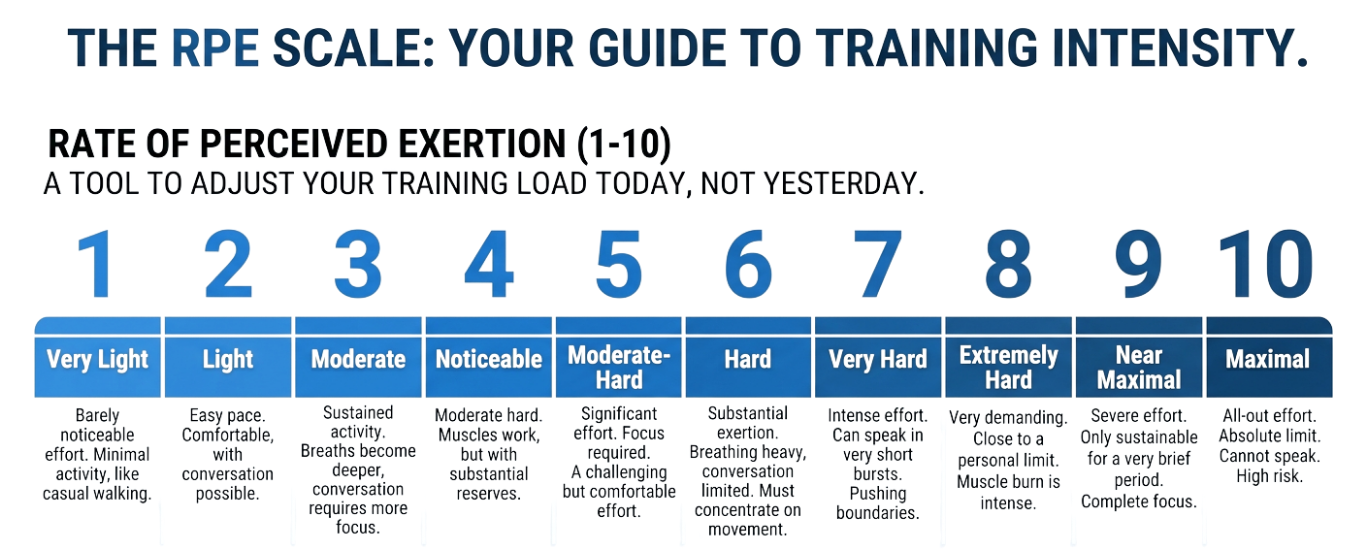
RPE Scale: Your guide to training intensity
By prescribing our effort based on how a weight feels today rather than what the number on the plate says, we ensure we are hitting the Minimum Effective Dose. This allows us to progress consistently without overshooting what our current recovery capacity can handle.
5. Putting The Plan Into Action
Here is the hardest truth: waiting for motivation can take forever.
When thinking about going back to activity, we need discipline and mental strength. Once we have built a plan, we need to put it into action. Only then, the good feeling, the feeling of proudness, the achievement, whatever drives you, will appear. And with that, will also come the motivation. The only way is THROUGH it !
A Final Word
I have been through training breaks a lot in my fitness journey. These insights were exactly what I missed on these times. Also, I never allowed myself to ask for help. This is why I am a personal trainer today. Together, we can develop your discipline, we can create and follow your plan. Together, we “get through it”.
Thank you for reading.
Ben.
